- We ship worldwide—please call us for a quote on international orders.
$749.99
Although the client is independent with the majority of power mobility, the remote stop system is used by a caregiver/assistant to stop the power wheelchair in situations where the client may temporarily lose control of the wheelchair.
Power wheelchairs provide users with greater freedom and independence, but there are situations where an additional layer of caregiver support can be valuable.
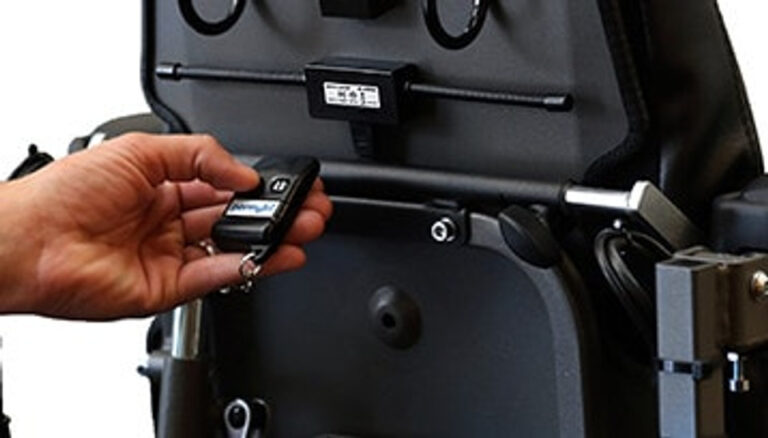
The Permobil Remote Stop System is designed for situations where a caregiver or assistant needs the ability to stop a power wheelchair remotely. It provides a handheld transmitter that communicates with a receiver mounted on the wheelchair, allowing the caregiver to activate the stop function without directly accessing the wheelchair’s joystick or main controls.
This type of system can be useful when a user is generally independent with power mobility but may occasionally experience a temporary loss of safe motor control.
For example, a caregiver may need to intervene when navigating a crowded environment, approaching a busy street or intersection, participating in wheelchair training, or responding to another situation where continued movement could be unsafe.
The system is designed as a remote stopping device, not as a replacement for responsible wheelchair operation or supervision.
The Permobil Remote Stop System uses radio frequency (RF) technology to communicate between the handheld transmitter and the receiver installed on the wheelchair.
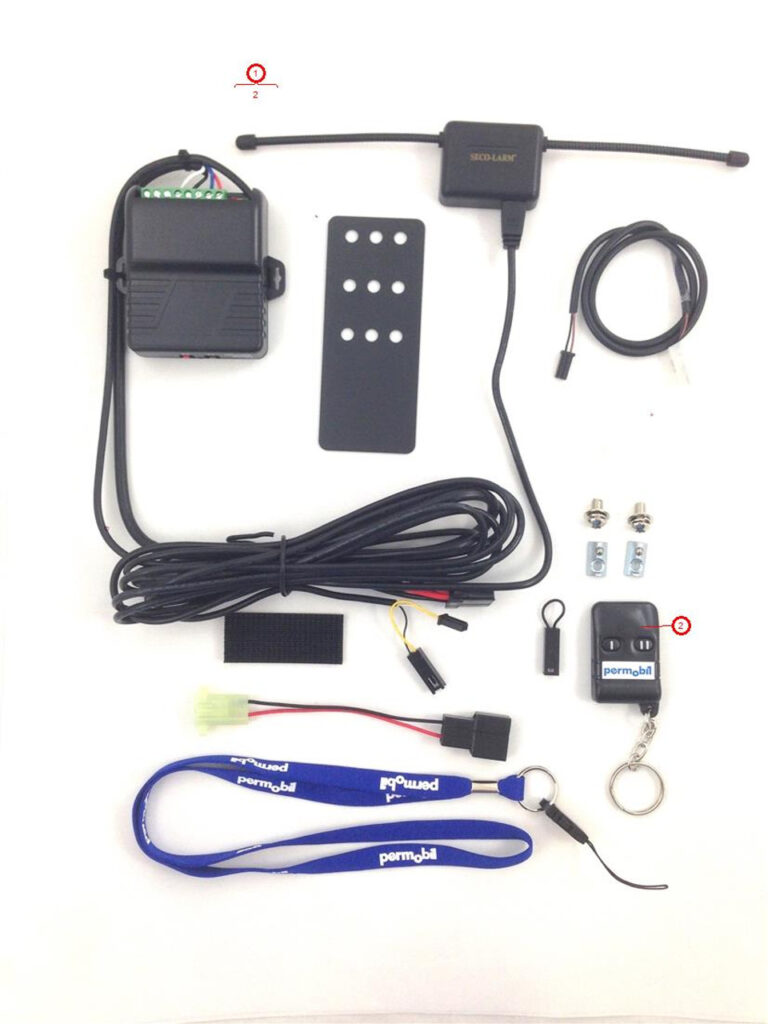
The system consists of two primary components:
When the appropriate transmitter button is activated, the receiver responds by activating the relay and stopping the wheelchair.
This wireless design allows the caregiver or assistant to carry the transmitter while remaining positioned near the wheelchair.
The system therefore provides an additional means of intervention when the caregiver cannot immediately reach the wheelchair controls.
The Remote Stop System is designed specifically for situations where a caregiver or assistant needs to stop the wheelchair.
It does not replace the user’s normal joystick control. Instead, it provides an additional safety-oriented control that can be used when intervention becomes necessary.
This is particularly relevant for users who are normally capable of independent power mobility but may experience temporary periods when they cannot safely operate the wheelchair.
The caregiver can keep the handheld transmitter available while the user drives independently.
This approach can help preserve the user’s independence while giving the caregiver an additional method of intervention when required.
One appropriate application for the Permobil Remote Stop System is power wheelchair training.
Learning to operate a power wheelchair requires practice. New users need time to become comfortable with steering, speed control, turning, stopping, and navigating different environments.
During this learning process, a caregiver, therapist, trainer, or assistant may want an additional way to stop the wheelchair if the user becomes unable to respond appropriately.
The remote transmitter allows the supervising person to activate the stop function from a distance.
This can provide an additional safety measure during training sessions while the user develops their wheelchair driving skills.
The system should be used according to appropriate training procedures and should not replace professional instruction or supervision.
The system may be useful when a user’s condition can occasionally result in a temporary inability to maintain safe motor control.
The provided product information identifies situations involving hearing or visual impairments, severe startle reflexes, seizure disorders, and other conditions that may temporarily affect safe wheelchair operation.
The important consideration is that the user may otherwise be capable of independent power mobility but have circumstances in which caregiver intervention becomes necessary.
In these situations, the Remote Stop System can provide an additional stopping method.
It should be viewed as a supplementary safety feature rather than a substitute for individualized clinical assessment or appropriate supervision.
Crowded environments can make power wheelchair navigation more challenging.
People may move unexpectedly into the wheelchair’s path, visibility can be restricted, and the user may have less time to respond to changing circumstances.
A caregiver accompanying the wheelchair user can carry the remote transmitter and be prepared to activate the stop function when necessary.
This provides another way for the caregiver to intervene without physically reaching over the user or attempting to operate the wheelchair’s joystick.
The system is intended to stop the chair when intervention is needed; it should not be treated as a general-purpose remote driving control.
Busy streets and intersections require particular attention from power wheelchair users and caregivers.
If there is a temporary loss of control or an unexpected situation, having an additional way to stop the wheelchair can be valuable.
The Permobil Remote Stop System allows an accompanying caregiver or assistant to activate the stopping relay using the handheld transmitter.
This provides an additional layer of control in situations where stopping the wheelchair quickly may be necessary.
Users and caregivers should continue to follow appropriate road and pedestrian safety practices. The remote stop system does not eliminate the need for attentive wheelchair operation.
The system operates using a wireless transmitter and receiver.
The receiver is installed on the wheelchair, while the caregiver carries the handheld transmitter.
The transmitter includes a button marked “I” that activates the stopping function.
When the button is pressed, the relay is activated and the wheelchair stops.
The relay remains activated until the system is reset.
To reset the system, the “I” button is pressed again, deactivating the relay and allowing the wheelchair to move again.
On compatible chairs with R-NET electronics, the relay can also be reset by switching the wheelchair off and then on again using the main power switch on the control panel.
The product information also states that this reset behavior is standard on chairs with Pilot+ electronics.
The relay is the key part of the system’s stopping mechanism.
When the transmitter’s stop button is activated, the receiver activates the relay. This causes the wheelchair to stop.
The relay remains activated until it is reset.
This means the wheelchair does not simply resume movement immediately after the transmitter button is released.
The system must be reset before normal movement can resume.
This design helps ensure that a stop command remains active until an appropriate reset action is performed.
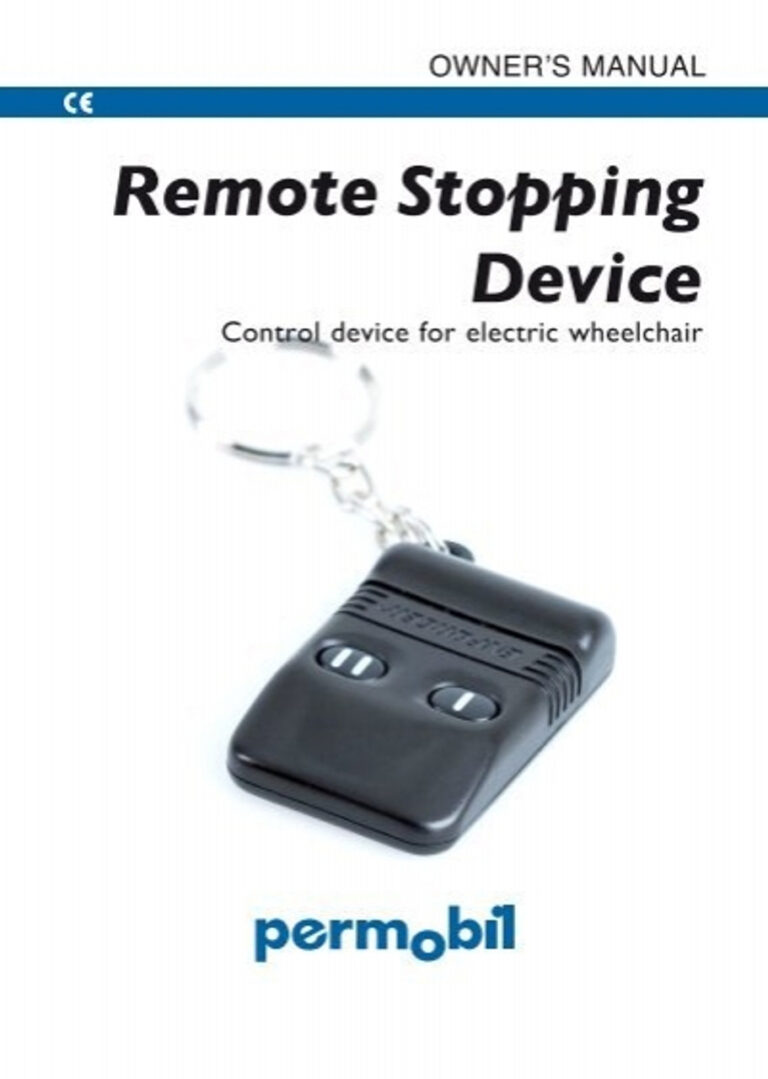
The Permobil Remote Stop System uses a 315MHz radio frequency handheld transmitter.
The transmitter provides the caregiver with a portable method of activating the remote stopping function.
Because it communicates wirelessly with the receiver, the caregiver does not need to physically access the wheelchair’s joystick to activate the stop command.
The handheld format also makes it practical for a caregiver or trainer to keep the transmitter readily available while walking alongside or supervising the wheelchair user.
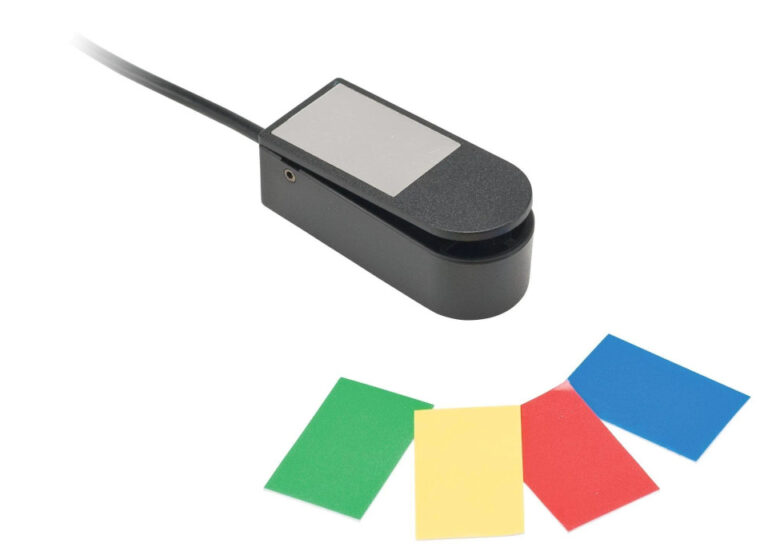
The second primary component is the RF receiver, which is mounted on the wheelchair.
The receiver communicates with the handheld transmitter and activates the stopping relay when the programmed transmitter button is pressed.
For the Permobil remote stopping system, the receiver’s antenna is fixed to the back of the wheelchair’s backrest.
The antenna should be positioned as high as possible while ensuring that it does not create a risk of injury to the user or damage to the equipment.
Correct antenna positioning is important for optimizing the operating range.
The antenna is an important part of the wireless system.
According to the supplied information, the antenna should be mounted as high as possible on the wheelchair backrest while maintaining safe clearance and avoiding interference with the user or wheelchair components.
The goal is to optimize the system’s range without creating a safety or equipment hazard.
Installation should therefore take into account both radio performance and physical safety.
If the system is being installed or serviced, a qualified technician should ensure that the antenna is positioned correctly.
The Permobil Remote Stop System can be used with compatible wheelchair electronic configurations, including chairs equipped with R-NET electronics.
On R-NET-equipped chairs, the remote stop relay can be reset by switching the wheelchair off and on again through the main power switch on the control panel.
This provides an additional reset method alongside pressing the transmitter’s “I” button again.
Because wheelchair electronics vary between models and configurations, compatibility should always be verified before installation.
The supplied technical information describes additional behavior for Pilot+ and VR2 wheelchair electronics.
On Pilot+ and VR2 chairs, the remote stopping device can be connected using constant current, meaning the remote stop system is not affected by the wheelchair’s power button.
For systems where the remote stopping device is fitted using the battery connection cables, the receiver receives constant current.
This means the equipment can continue drawing power even when the wheelchair itself is switched off.
Because of this, the product information emphasizes that the batteries should always be kept charged when this type of connection is used.
These electrical connection details should be handled by a qualified wheelchair technician.
Battery management is particularly important when the receiver has a constant-current connection.
If the receiver continues drawing power while the wheelchair is switched off, leaving the wheelchair unused for an extended period without maintaining the batteries could affect battery charge.
For this type of installation, keeping the wheelchair batteries appropriately charged is important.
Users should follow the wheelchair manufacturer’s battery charging and maintenance recommendations.
Electrical modifications or connections should not be performed without the appropriate technical knowledge.
One of the most important points about the Permobil Remote Stop System is that it must only be used to stop the wheelchair.
It is not designed to function as a parking brake.
The remote stop device should not be relied upon to secure a wheelchair when it is parked, especially on slopes or in situations where the chair needs to remain stationary for an extended period.
Users and caregivers should follow the wheelchair manufacturer’s instructions for safely parking and securing the power wheelchair.
Understanding this distinction is essential for safe use of the remote stop system.
The receiver can be programmed to recognize a specific transmitter button on channel 1.
The supplied instructions identify button #1 on the receiver, located beside the “Mode switch” text, as the programming control.
To program a new transmitter button, the receiver’s button #1 is pressed and held for approximately three seconds.
The green diode then begins flashing rapidly, indicating that the receiver has entered programming mode.
The “I” button on the transmitter is then pressed.
The green diode flashes and then turns off, confirming that the transmitter button has been programmed.
Channel 2 is not used according to the supplied information.
The receiver’s programming mode has a limited window.
The green diode flashes for a maximum of approximately 15 seconds.
If no transmitter button is pressed during this period, the receiver exits programming mode and the green diode switches off.
This timing is important when programming a transmitter because the button on the handheld unit needs to be pressed while the receiver is actively waiting for the code.
The receiver also provides a procedure for deleting programmed transmitter codes.
To delete all programmed codes, press the receiver’s Mode switch button #1 for three seconds.
When the diode begins flashing, press the same button again and hold it for another three seconds.
The LED will then flash twice to confirm that the programmed codes have been deleted.
This procedure should be performed carefully because deleting the codes removes the transmitter codes that have previously been programmed into the receiver.
The receiver can only be programmed with a specific button code once.
If an attempt is made to program a button code that has already been programmed, the receiver exits programming mode, regardless of whether the code is associated with the same channel or another channel.
This means programming should be approached carefully, particularly when replacing or reconfiguring transmitters.
Following the supplied programming procedure helps ensure the receiver recognizes the intended transmitter button.
The Permobil Remote Stop System may be useful for power wheelchair users who are generally independent but require occasional caregiver intervention.
Potential applications include:
Suitability should be determined according to the user’s individual needs, wheelchair configuration, and professional recommendations.
The Permobil Remote Stop System provides several important features:
The Permobil Remote Stop System is designed around a simple but valuable idea: allowing a caregiver to intervene without taking away the user’s normal control of the wheelchair.
For a user who is independent most of the time, this can provide a balance between autonomy and additional supervision when circumstances require it.
The caregiver maintains access to the remote transmitter while the user continues operating the wheelchair normally.
When an appropriate stopping situation occurs, the caregiver can activate the remote stop function.
This makes the system particularly relevant for training and situations where temporary intervention may be necessary. visit the official Permobil makers site
The Permobil Remote Stop System is a specialized wireless safety accessory designed to give a caregiver or assistant an additional way to stop a compatible power wheelchair.
Using a 315MHz RF handheld transmitter and wheelchair-mounted receiver, the system activates a relay when the designated “I” button is pressed. The relay remains activated until it is reset, providing a deliberate stopping mechanism rather than an immediate automatic restart.
The system can be useful during power wheelchair training, in crowded environments, near busy streets and intersections, or when a user’s condition may temporarily affect safe motor control.
It is important to remember that the remote stopping device is intended only for stopping the wheelchair and must not be used as a parking brake. Battery and electrical connection requirements also vary depending on the wheelchair’s electronics and installation method.
| Permobil Remote Stop System: | Permobil Remote Stop System |
|---|---|
| Comapatability: | All Permobil Models |
Only logged in customers who have purchased this product may leave a review.






Reviews
There are no reviews yet.